

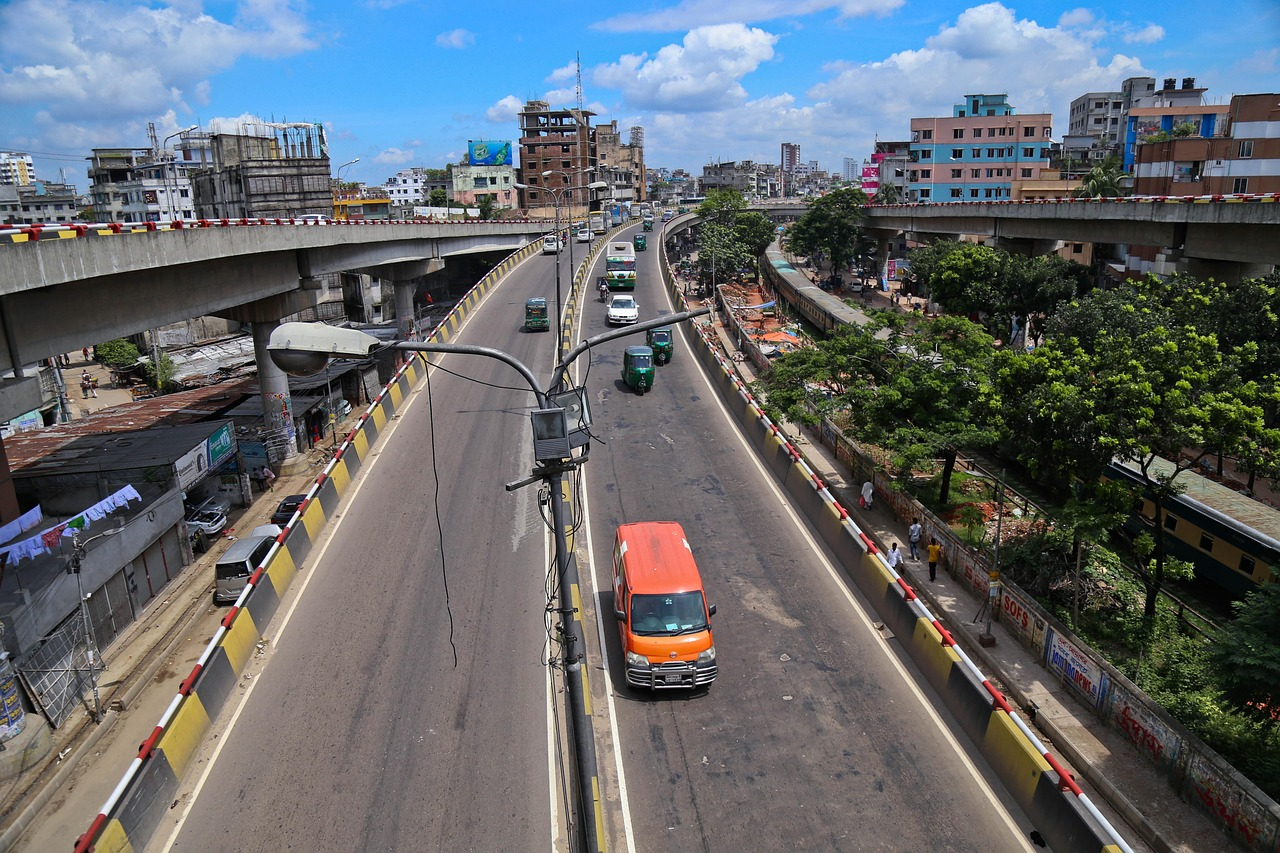
Jaywalkers in Bangladesh love to dive even onto the road reserved for speeding vehicles. Nothing can stop them from maneuvering their movement on roads occupied by traffic. They surmount every obstacle put in their way. Be it a metal net or some other object, they find a way to deal with it. Even if the Great Wall of China were transported as a road divider in Dhaka, it seems that they would still be able to cross it. They know how to slide their body through a narrow metal grille opening installed to deter jaywalkers from crossing the busy road. No matter what time it is, they always put their feet onto the road to reach the other side.
Various measures, including legal measures, have been taken by the concerned authorities, but jaywalking remains prevalent. Bangladeshis have developed this habit to navigate heavy traffic by being physically present on the road. Although foot overbridges are built to facilitate crossing from one side of the road to the other without disrupting traffic flow, they remain often unused. To save time, pedestrians prefer not to use them. The norm of not using the foot overbridge has reached new heights in Bangladesh. Moreover, foot overbridges are always occupied by vendors and beggars, making the walk very difficult. If pedestrians had the option not to use overbridges, they probably would not have used them; rather, it would have appeared to be as arduous as climbing mountains.
Hands are an important part of pedestrians crossing the busy road. Pedestrians use their hands to stop approaching vehicles, climb the road dividers, and repeat the same on the other side of the road. They learn it by observing others. They have their own reasons, no matter whether it is acceptable or not: if they do not use their hands, vehicles do not bother to stop, requiring them to run quickly to reach the road dividers. They learn to cross the road by using their hands at a normal pace.
Although Bangladeshis know about the risks, they still do it repeatedly. It is like playing with fire when it comes to crossing the road. People know they may be run over, but they seem to be sanguine about their success in crossing the road. Just as practice makes a person perfect, pedestrians seem to keep practicing to perfect the skill of throwing themselves onto the road and avoiding accidents. They seem to walk, run, and jump to get closer to their destinations like Edgar Rice Burroughs’ Tarzan. Even when a road is being dug to install a sewage pipe or an electric line, they know find room for their bodies to land safely on the road divider.
In many countries, jaywalking is a crime, though it is not in all countries. The power of enculturation is highlighted by monetary fines. Pedestrians are taught not to cross the road because crossing may cause accidents and hinder traffic flow. As people learn by observing others’ lack of respect for the time regime, it disrupts the flow of traffic on the road. Waiting for the appropriate time is taught to learn to expect one’s turn systematically. Fines are not the solution; it is for everyone’s understanding and civic duty that room for everyone is the rule. It is also true that citizens are not robots, so rules may be broken to be disciplined by the system.
Foucault’s ‘Discipline and Punish’ may help us understand the existence of the prison model in our daily lives. James Scott, in his book ‘Two Cheers for Anarchism,’ came up with the term ‘anarchist calisthenics’ to interpret a simple act of jaywalking in the context of two European cities. In Neubrandenburg, Germany, and Wageningen, Netherlands. He saw that residents never even thought of jaywalking, let alone did it. They discouraged anyone who would be tempted to cross the road when the light was not lit in favor of the pedestrians.
One Dutch scholar, Dr. Willem Frederik Wertheim, who was walking with Scott, scolded him for trying to do it even when no vehicle was seen coming, saying it would be a bad example for children. So, he said jokingly that next time, when he did it, he would ensure that no child was around. Although it did not happen, the attempt to do so would be considered an act of anarchism.
In the Bangladeshi context, jaywalking is not an example of anarchist calisthenics. Here, roads have been forced to forget their role in carrying passengers. Instead, they are used for parking, keeping goods from the shops, mobile food carts, and whatnot. Roads cry for their original status to be restored. Their rights are violated without their consent. They never agreed to be used for multiple purposes. They are not multipurpose halls. Calisthenics on the road is the rule, where anarchism acts like the constitution. Total chaos, born of daily anarchism, dominates the roads. Eternal traffic congestion stems from a lack of respect for the rules.
In Bangladesh, jaywalking is one aspect of rule-breaking. Rule-breaking occurs in many other sectors. Jaywalking is a mirror through which the psyche is made visible. Moreover, it is difficult to end the habit overnight. But measures are needed to address reckless jaywalking. It is vital to enforce the existing laws in a regular manner, along with keeping awareness-raising campaigns ongoing, to address it and bring it down to a tolerable level.
It is true that not everyone can use a foot overbridge. Pregnant women, senior citizens, and those who are dealing with health complications cannot use it. Some foot overbridges have escalators to help these people. But most of the time, the escalators remain out of service or out of order. Sometimes one or two steel sheets are missing in some foot overbridges, making the experience very risky and scary. The users can see the road clearly through the large gap left by the missing sheets. To keep the bridge functional, a wooden board is placed d ed to help users reach the first step of the descending escalator. But these need to be addressed too.
DISCLAIMER: The views expressed are those of the author(s) and do not necessarily reflect the official policy or position of the Magazine, or its editorial team. The views published are the sole responsibility of the author(s).
