

Bangladesh has made an improvement in the corruption score. The Transparency International Bangladesh (TIB) released the 2025 Corruption Perceptions Index (CPI) report 2025 in Dhaka on 10 February 2026. According to the CPI 2025 of the Berlin-based Transparency International (TI), Bangladesh’s score on corruption has increased by one point from 2024 to 24 in 2025, with its ranking rising one step to 150th out of 182 countries in ascending order. This is the second-lowest score Bangladesh has achieved in 14 years since 2012. But this does not indicate substantial changes in the state of corruption, which CPI defines as the “abuse of public power for private gain” and legal structures following the fall of authoritarian rule.
The corruption findings of the TI were revealed at a press conference as part of the global CPI 2025 release. The CPI measures corruption perception on a scale of 0–100, where 0 represents the highest corruption and 100 the least corruption or highest governance quality. No country has achieved a perfect score, meaning corruption exists even in the least corrupt countries. Of the 182 countries, two-thirds (122 countries) scored below 50. Compared to last year, 48 countries improved, 68 declined, and 64 remained unchanged. Since 2012, 31 countries have improved, while 50 countries have worsened. Among the eight South Asian countries, five countries recorded score improvements ranging from 1 to 3 points. Two countries experienced a decline of 1 point each, while one country’s score remained unchanged. Sri Lanka recorded the highest increase with 3 points, while Bangladesh, India, Pakistan, and the Maldives each improved by 1 point. Bhutan and Afghanistan saw their scores decline by 1 point each, while Nepal’s score remained unchanged.
TIB’s Executive Director Dr. Iftekharuzzaman highlighted Bangladesh’s position on corruption, stating, “According to the CPI, on the 0–100 scale used since 2012, Bangladesh’s score fluctuated between 25 and 28 until 2022. However, in 2023 and 2024, the score consecutively declined by one point each, to 24 and 23, respectively, before increasing by one point this year to 24. Trend analysis of the CPI shows that, compared to 2012, Bangladesh’s score this year is two points lower… Among the 182 countries included in the index, Bangladesh ranks 13th on the list of lowest-scoring countries.” Regarding the improvement in corruption in Bangladesh, he further said, “The one-point increase in the score this year reflects the effect of the unrealized positive prospects for achieving democratic and accountable governance signaled by the July uprising. However, it does not reflect the subsequent reality of the state reform process, as the relevant data sources were not yet updated.”
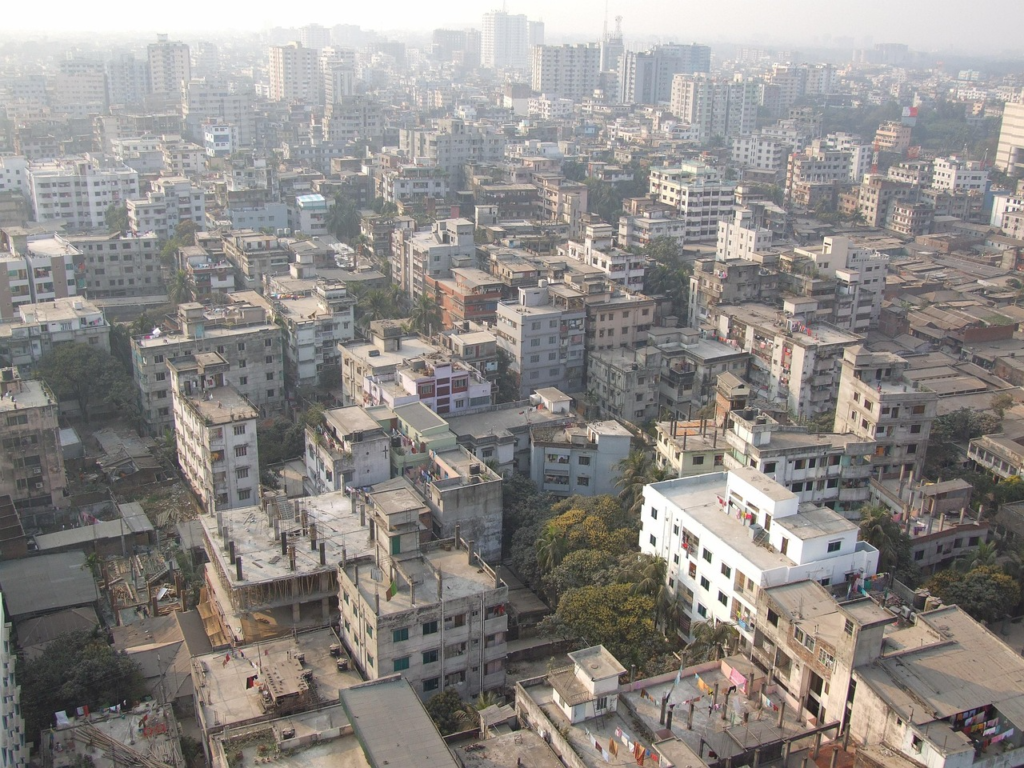
Dhaka, Bangladesh (credit: https://pixabay.com/).
Over the past one and a half years, the interim government, which came to power in August 2024 through the July-August mass uprising, has failed to take effective and exemplary measures against corruption in Bangladesh, the country that scored far below the index’s global average this year. Moreover, due to the influence of the bureaucracy and various politically and otherwise powerful actors, as well as the neglect or non-implementation of reform proposals put forward by the Anti-Corruption Commission (ACC) and other relevant institutions responsible for combating corruption in Bangladesh, these institutions have also failed to carry out their actual roles, leading to a little improvement in corruption in Bangladesh.
Highlighting the government’s failure to curb corruption, Dr. Iftekharuzzaman said, “According to this year’s analysis of the index, Bangladesh is among the countries that have failed to rein in corruption. In South Asia, Bangladesh ranks second-lowest after Afghanistan in both score and position. Bangladesh’s score (24) is 18 points below the global average (42) and 21 points below the Asia-Pacific regional average (45). Even compared to countries in the most corruption-prone region, sub-Saharan Africa, Bangladesh’s score is 8 points lower. Therefore, the level of corruption in Bangladesh is highly concerning. According to this year’s CPI, among the 182 countries, the average score of fully democratic countries is 71, that of flawed democracies is 47, and that of non-democratic countries is 32.”
Explaining the latest results of the CPI, the TIB Executive Director says, “This means that fully democratic countries are far more effective in controlling corruption compared to flawed democracies, non-democratic, or authoritarian states. Meanwhile, analysis of the CPI scores according to civic space shows that countries with full civic space have an average score of 68; those with limited or restricted civic space, 51; countries where civic space is obstructed, 38; those with repressive space, 32; and countries with no civic space, 30. Based on this analysis, Bangladesh falls into the category of a non-democratic or authoritarian state with no civic space.”
TIB plays no role in determining the CPI. Even information or analysis generated from TIB’s own research cannot be included in the CPI. Like TI chapters in other countries, TIB only publishes the CPI at the national level. Analyzing Bangladesh’s position on corruption, the TIB Executive Director further said, “Even after the mass uprising, the nation’s expectations have not been met, and the foundation for state reform remains fragile. In particular, a section of the bureaucracy and political parties is obstructing the necessary reform proposals required to ensure accountability.”
To address this dire condition of corruption, Dr. Iftekharuzzaman called on political parties not to implement reforms according to their preferred “pick and choose” approach, but to pursue sustainable and comprehensive reforms as required by the state. He added, “Although the kleptocracy has ended, money laundering has not stopped; on the contrary, it has been reinstated.”
NB: Dhaka Opinion Magazine does not send its editorial team members to cover press conferences, conferences, seminars, workshops, or any other event. It selectively publishes Opinion Roundup, Conference Overview, and Convention Overview when opinion-based press releases, conference proceedings, or other similar materials are submitted or sent to the magazine. But these are subject to editing before publication based on the policy of the magazine.
DISCLAIMER: The views expressed are those of the authors and do not necessarily reflect the official policy or position of the Magazine and its editorial team. Views published are the sole responsibility of the author(s).
