


What with mounting federal debt, persistent fiscal deficits, aggressive monetary tightening, and a progressively fragmenting reserve currency system, US Treasury bonds — long regarded as the bedrock of global finance — now sit at the center of an unfolding global imbroglio. For decades, Treasuries functioned as the ultimate risk-free asset, anchoring the dollar’s reserve status and stabilizing trade, capital flows, and sovereign balance sheets across continents.
Their credibility was not merely financial; it was geopolitical, underwriting the architecture of the postwar international order and enabling the United States to exercise outsized influence through monetary dominance. Yet the convergence of fiscal strain at home and strategic recalibration abroad has rendered this once-unquestioned foundation increasingly contested. What was assumed to be structurally permanent now appears historically contingent, exposed to political brinkmanship, market volatility, and the gradual multipolarization of global finance.
At the domestic level, the United States faces a precarious fiscal landscape. Federal debt has climbed past $38 trillion, with debt held by the public near or above 100 percent of GDP, intensifying concerns about long-term fiscal sustainability. Inflationary pressures have prompted the Federal Reserve to maintain elevated interest rates, increasing the cost of borrowing and contributing to volatility in Treasury yields. Investors — both domestic and international — are increasingly questioning whether the US can sustain its debt burden without undermining confidence in Treasuries or the dollar, which weakened notably in 2025 amid policy uncertainty and shifting rate expectations.
This uncertainty has also surfaced in political and monetary tensions. The Trump administration has publicly pressured Federal Reserve leadership to lower interest rates, while the Fed has opted to hold rates steady, highlighting the divergence between short-term political aims and long-term macroeconomic stability. Although there is no formal policy to deliberately devalue the dollar, market-driven depreciation has partially enhanced the competitiveness of US exports, illustrating how fiscal and monetary uncertainty can influence both domestic and global economic dynamics. Together, these factors contribute to a growing perception that Treasury bonds, long regarded as risk-free, are increasingly exposed to political, fiscal, and economic shocks, while the dollar’s stability faces mounting questions — an intersection of concerns that underpins broader global financial and geopolitical reverberations.
Internationally, the composition of Treasury holders is evolving in ways that exacerbate structural vulnerability. Historically, China and Japan have been the largest foreign holders of US debt, stabilizing markets through consistent demand for Treasury securities. In recent years, however, both countries have reduced exposure to US Treasuries, reallocating capital to other currencies, regional financial markets, or sovereign assets perceived as safer amid rising volatility. India, too, has trimmed its Treasury holdings intermittently, reflecting a broader strategy of reserve diversification and currency management. Emerging economies more broadly are diversifying reserves to shield themselves from potential dollar depreciation, interest-rate shocks, and geopolitical risk associated with sanctions or financial weaponization.
This recalibration is increasingly institutionalized within the expanding framework of BRICS Plus, whose strategic pivot includes strengthening trade settlement in local currencies, developing alternative payment systems, and promoting reserve diversification away from exclusive dependence on the dollar. While the dollar remains dominant in global reserves and trade invoicing, the incremental shift toward euro-, yuan-, gold-, and other currency-denominated assets reflects a gradual — though not yet revolutionary — movement toward de-dollarization.
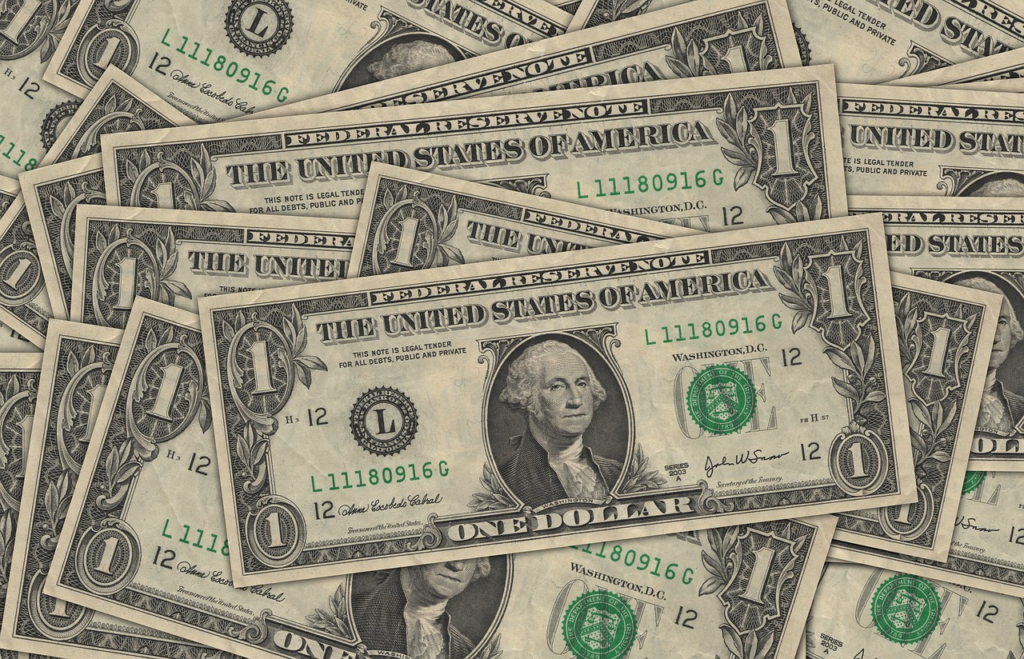
US Dollar RS credit: https://pixabay.com/).
Sovereign wealth funds and central banks are hedging against volatility in US fiscal and monetary policy, signaling that the era of unquestioned dollar centrality is evolving into one of cautious multipolar adjustment. As reserve diversification accelerates, the United States’ ability to project economic influence through its debt markets may gradually weaken, constraining one of the principal levers that has historically undergirded its global financial power.
This fiscal and financial uncertainty is closely reflected in the United States’ increasingly aggressive and unhinged foreign and trade policies. Treasury volatility weakens the soft power traditionally derived from the US dollar’s reserve status and compels policymakers to rely increasingly on coercive tools. Trade measures, including tariffs, sanctions, and export controls, have become more frequent, targeted, and often punitive. In parallel, military posturing—ranging from shows of force in contested regions to strategic interventions abroad—appears increasingly unrestrained, a function of a strategic calculus that seeks to offset declining economic leverage with hard power. In essence, Treasury instability incentivizes risk-taking: if confidence in US debt falters, the country seeks to assert influence through immediate and tangible displays of power, whether economic, diplomatic, or military.
Historical patterns reinforce this link between Treasury stress and aggressive policy behavior. During the 1980s, the Latin American debt crisis emerged in the context of rising US interest rates, fiscal deficits, and fluctuating capital flows. The US responded not only through financial interventions but also through political pressure and strategic support for regimes aligned with its interests, including coercive measures to secure debt repayment.
Similarly, in the post-2008 era, the Federal Reserve’s quantitative easing and large-scale interventions were accompanied by a period of assertive trade negotiations, military engagements, and sanctions, reflecting a persistent interdependence between domestic fiscal policy and international assertiveness. Today, Treasury volatility is contributing to an analogous pattern: uncertainty in debt markets fosters a proclivity for decisive, sometimes unrestrained, policy moves to compensate for eroding financial credibility.
Emerging powers have recognized and exploited these fissures. China, for instance, has expanded its Belt and Road Initiative and regional financial infrastructures precisely at a time when the United States is grappling with domestic debt concerns and Treasury volatility. The European Union, too, is strengthening its financial architecture through the euro’s gradual internationalization and regional capital markets. Meanwhile, emerging economies reliant on US dollar liquidity for trade, commodity imports, and debt servicing are acutely vulnerable. Treasury turbulence can trigger capital flight, currency depreciation, and debt crises in these countries, creating a cascade of systemic risks.
The Treasury imbroglio is not an isolated financial disturbance; it signals the slow but unmistakable erosion of unipolarity in global finance. The post-Bretton Woods order — anchored in the dollar and enforced through US-dominated institutions — is no longer structurally unquestioned. Multipolar financial nodes are consolidating. Regional payment systems, gold accumulation, alternative reserve holdings, and sovereign wealth diversification all indicate that dollar centrality, while still dominant, is no longer absolute. The United States can no longer assume that its debt markets will function as an unchallengeable instrument of geopolitical discipline, nor that sanctions, trade restrictions, and monetary tightening will automatically compel compliance.
In this context, fiscal fragility does not produce caution; it often produces overcompensation. As financial leverage becomes less deterministic, strategic behavior hardens. Venezuela exemplifies this dynamic: the prolonged sanctions regime operates not merely as moral posturing but as a sustained attempt to weaponize financial access and energy markets in a system where monetary supremacy is increasingly contested. Greenland, meanwhile, represents a different vector of the same impulse — an intensified geopolitical fixation on Arctic corridors, rare earth deposits, and a strategic positioning in anticipation of resource competition in a fragmented order. These are not disparate episodes; they are symptoms of a late-hegemonic reflex. When soft power rooted in financial credibility weakens, the recourse to coercive trade measures, extraterritorial sanctions, and muscular strategic signaling becomes more pronounced.
The underlying pattern is stark. Treasury volatility undermines the aura of permanence that sustained dollar hegemony. As that aura fades, the projection of power grows more conspicuous, more transactional, and at times, more destabilizing. What appears as assertiveness abroad may in fact be an attempt to stabilize the eroding leverage at home.
Policy responses must therefore be multidimensional and forward-looking. Domestically, debt ceilings must be managed responsibly, fiscal consolidation must be prioritized, and inflation must be contained. Long-term confidence in Treasury instruments depends not only on short-term economic interventions but on sustained credibility in public finance. Internationally, the United States must engage diplomatically with major Treasury holders and work in concert with multilateral institutions to mitigate systemic risk. Simultaneously, emerging and middle powers must prepare for heightened volatility, building buffers, strengthening regional financial coordination, and diversifying reserves to reduce vulnerability to US-centric shocks.
The Treasury imbroglio exposes how fiscal fragility translates directly into geopolitical assertiveness: as confidence in US debt wavers, reliance on financial leverage diminishes, compelling policymakers to deploy trade coercion, sanctions, export controls, and military measures as compensatory instruments of influence. This entanglement of finance and strategy amplifies risk, reshaping global calculations, intensifying regional tensions, and accelerating the fragmentation of the world economic order into competing spheres. Treasury volatility thus serves as both a barometer and driver of multipolarity, signaling that unassailable credibility has given way to a landscape of uncertainty and opportunity, where the interplay of domestic fiscal discipline, strategic diplomacy, and international financial coordination will determine the contours of power, economic integration, and global stability for decades to come.
The imbroglio of US Treasury bonds is not a technical footnote; it is a synecdoche for a world order in transition. Within the tremors of the Treasury market lies the strain of fiscal excess, the politicization of monetary authority, and the gradual diffusion of dollar hegemony. Beyond finance, it signals the emergence of a multipolar, contested global system, where the reliability of traditional levers of influence is diminishing and the future of economic integration and strategic equilibrium hangs in balance. Understanding this imbroglio is not optional —it is essential for navigating a world in which domestic decisions ripple outward, shaping the architecture of power, cooperation, and contestation for decades to come.
DISCLAIMER: The views expressed are those of the author(s) and do not necessarily reflect the views or official position of the Magazine and its editorial team. The views published are the sole responsibility of the author(s).
