

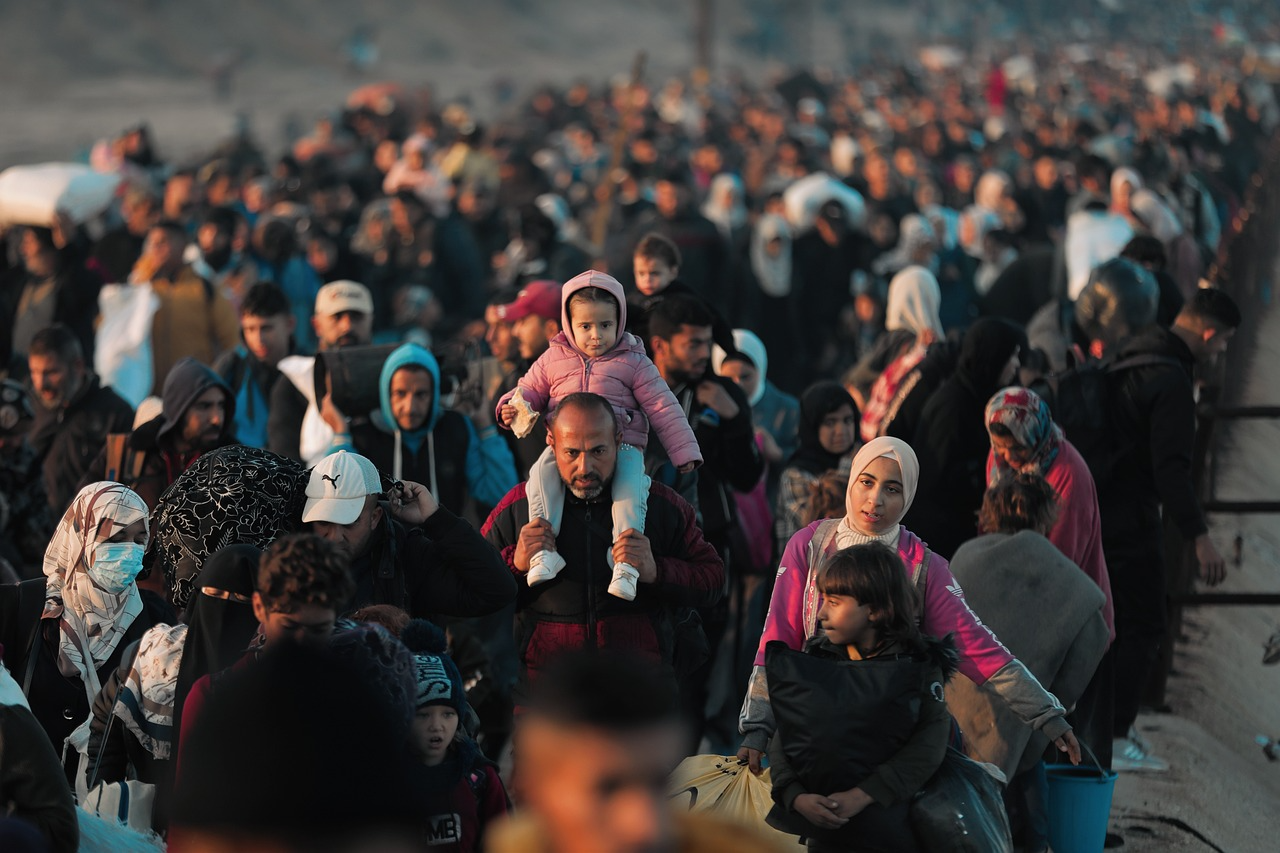
Displacement is one of the major problems globally. As per the reports of multiple sources, including the BBC and CNN, millions of people are displaced all over the world. In the Middle East alone, there are several million displaced persons due to the Israel-Lebanon war, the Syrian War and the Yemen War. Even if the number of the displaced has decreased globally through mass returns to countries such as Syria and Afghanistan, it is still scant. Though the displaced get different sorts of facilities in the refugee camp situations, such as shelter, food and opportunities to earn money, their human development potentials are drastically reduced, leading to concerns.
Human development indicates the development of human beings. It is the realization of human potential with the development of various dimensions, along with the surmounting of animality. Human development is a social and individual process and it is a staged process that occurs through four stages such as consciousness, consciousness based reasoned choices, plans and strategies for the realization of reasoned choices and the realization of reasoned choices. For human development, combined capabilities such as social conditions and individual capabilities are needed. These are needed to realize human potential and surmount animality. Conducive combined capabilities — physical and mental fitness, educational opportunities, income opportunities, political freedom, cultural freedom and so on — facilitate human development, while the paucity of these hinder such development.
The human development of the displaced is drastically compromised, compared to those who are in a normal situation, as displacement significantly limits the combined capability. In the usual situation, there are more opportunities and options in terms of education, income opportunities, political freedom and so on, even if the extent of such opportunities varies in different contexts. Consequently, there are better social conditions and a greater chance of realizing different human potentials. But in displaced situation, opportunities are very limited. There are systemic barriers to the displaced in refugee camps all over the world. Social conditions given in the refugee situations are consequently not conducive to human development.
The displaced are deprived of education (especially higher education, even if some sorts of educational opportunities are given) and income opportunities. Refugee camps are rendered as temporary shelters and the displaced do not have citizenship opportunities, leaving no options for the rights that citizens enjoy in a given territory. Consequently, they do not have political freedom, even if some displaced conditions provide certain forms of political freedom. The displaced are mostly constrained in a small area and have limited freedom of movement. Moreover, they have limited social participation outside the camps and many other limitations that directly impact their capability for human development in the camp situation.
The refugee camp situation breeds aid dependency and leaves families highly vulnerable and uncertain. Though international organizations and community-based programs strive to bridge this gap and the global fund exceeds ten billion USD annually — especially on refugees and their hosting solutions — opportunities are scant, even in highly structured, well-funded and well-facilitated camps, including the Hagadera Refugee Camp in Kenya, Zaatari Refugee Camp in Jordan and Bidibidi Refugee Settlement in Uganda. The situation of most refugee camps, including the DRC Mugunga IDP (Internally Displaced Persons) Camps, Palestine Refugee Camps and Mbera Refugee Camp (in Mauritania), is vulnerable and dilapidated, leaving the displaced with limited opportunities for their human development.
The lack of conducive social conditions that provide limited options impacts individual capabilities, such as the capability of the displaced in becoming conscious about themselves and the world, making informed and reasoned choices, making plans and strategies to realize their potentials, and realizing many of the reasoned choices. Alternatively saying, millions of those who are displaced and live in different refugee camps in the Middle East, Africa and other regions fail to realize their human potentials. Many do actually accept that the camp situation is their reality, which does not have any way out. Even if they can realize their certain human potential, their choices and realization are very limited, not to the highest possible extent.
Conflicts are one of the vital reasons for displacement, though other reasons, such as natural disasters and development projects, also lead to displacement. The latter is often short-term but the conflict/war-caused displacement is long-term and often takes decades for the displaced to resettle in their or other communities and integrate locally from their protracted displacement situation. Palestinian refugees caused by the 1948 Arab-Israeli conflict have not yet been able to resettle, even if they have been displaced for decades. There are many other examples, including Afghan refugees (caused by the 1979 Soviet invasion) and Sahrawi Refugees (caused by the conflict over the territory of Western Sahara since 1975), who have lived in refugee camps for several decades.
In refugee situations, human potentials will be limited, even if opportunities are increased. Unless the refugee situation is ended through the repatriation, local integration or resettlement of the displaced into other places, economic, social, political and other opportunities need to be increased as much as possible. These will somewhat increase the combined capability of realizing many of the human potentials — though it is still much less compared to that of the normal situation. But the emphasis needs to be given to end the refugee situation as early as possible. For this, the world system needs to do much.
But the reasons for the displacement, especially wars, need to be addressed so that displacement does not take place. For this, mechanisms need to be strengthened to prevent the occurrence of unjust wars and mitigate wars as early as possible. Along with international organizations, powerful countries need to do a lot. But the responsibility of powerful countries and groups within countries is more. They can drastically reduce the chance of wars and displacement.
