


Despite state commitments and global pledges, the continued strategic dominance and over-reliance on fossil fuels have become the primary obstacles to the growth of renewable energy-based power generation. Governance deficits, policy neglect, and collusion by vested interest groups are creating long-term environmental and economic risks in the renewable energy sector. This alarming picture has emerged in a research report by Transparency International Bangladesh (TIB) titled “Generating Power from Renewable Energy in Bangladesh: Governance Challenges and Way Forward.” The report was presented in a conference held on 24 December 2025 in Dhaka and attended by TIB officials, including Dr. Iftekharuzzaman (Executive Director), Dr. Sumaiya Khair, and Muhammad Bodiuzzaman.
The conference of the TIB highlights that the interests of the fossil fuel lobby are being protected by marginalizing renewable energy in the energy sector’s master plans, resulting in the failure to realize the vast potential of renewable energy in Bangladesh. As per the information presented on the basis of the study, 96.7 percent of foreign investment in Bangladesh’s power sector goes to fossil fuels, while only 3.3 percent goes to the renewable sector, which is both environmentally harmful and economically suicidal. Under the influence of domestic and foreign lobbies, plans are being made to restart cancelled coal-based energy projects, which contradict national and international commitments. Essentially, the renewable energy sector is now at risk of being held hostage by corporate entrepreneurs.
Highlighting the power sector’s dependence on fossil fuels, Dr. Iftekharuzzaman said, “A purposeful over-reliance on fossil fuels has been created through a long process of policy capture driven by conflicts of interest…Budgetary allocations for the renewable energy sector are negligible compared to the requirement. Renewables have been neglected rather than receiving due priority in policy. Various inconsistencies and ambiguities have been created in energy sector policies, strategies, and plans. Specifically, the Integrated Energy and Power Master Plan (IEPMP) was formulated under the influence of the fossil fuel lobby, centered on fossil fuels, which is why policy, institutional, and financial incentives were not provided to renewable energy. Conversely, instead of actual renewable energy, priority is being given to untested, so-called ‘green energy’”.
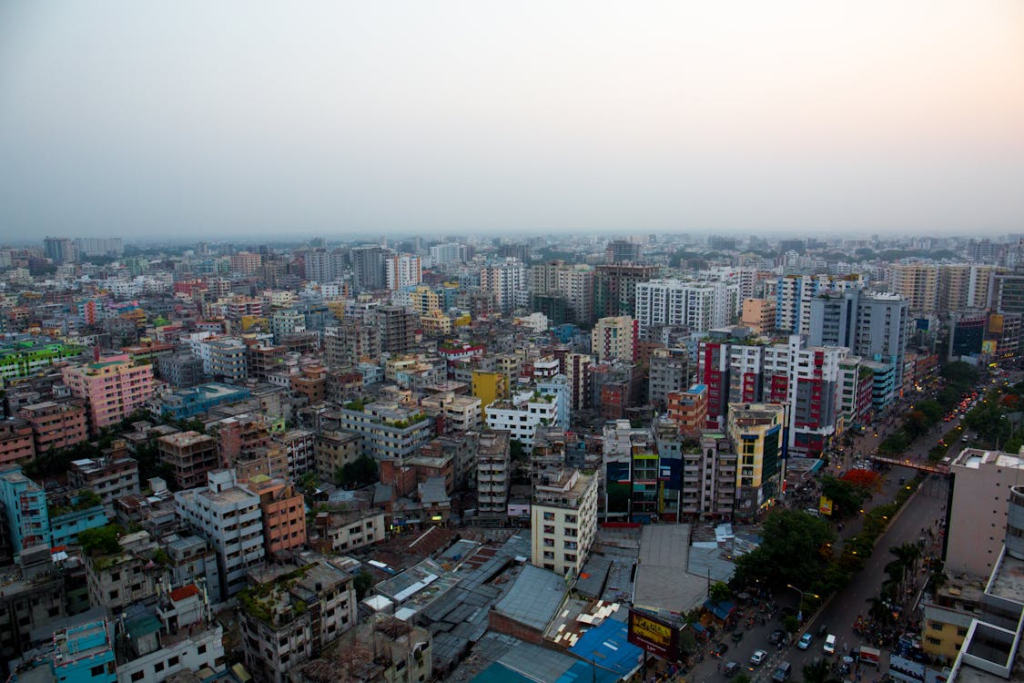
Dhaka, Bangladesh (credit: https://pixabay.com/).
As the conference of the non-government anti-corruption organization highlights, the corruption scenario shows that while BDT 8 crore per megawatt is required for solar power projects according to the Bangladesh Power Development Board (BPDB), the six projects covered by the research had an average estimated cost of BDT 13.8 crore. Alternatively saying, BDT 2,926.88 crore of state resources were wasted through inflated cost estimates. Furthermore, a powerful syndicate has emerged for land purchase, consisting of a section of IPP officials, the union and upazila land office staff, and local public representatives.
The TIB research found that the “Quick Enhancement of Electricity and Energy Supply (Special Provision) Act, 2010” is being misused to sign power purchase agreements based on personal relationships at high tariffs instead of competitive bidding, which are nearly four times higher than in neighboring countries. Furthermore, the cost of solar power projects has been estimated to be on average 1.5 times higher than the actual cost, leading to an estimated additional expenditure of approximately BDT 2,926.88 crore. In the five projects covered, more than BDT 249 crore in corruption occurred regarding land purchase and compensation. This corrupt money was distributed among a section of IPP officials, local land office staff, and influential politicians and members of parliament.
Commenting that the argument of land scarcity as a barrier to renewable power generation in Bangladesh is scientifically baseless, the TIB Executive Director added that, “It is regrettable that even in the limited investments made in the renewable energy sector, instances of various irregularities, wastage of funds, and collusion-based corruption were observed in the projects covered by the study. During the era of the fallen kleptocracy, the fossil fuel-based power sector was one of the most corrupt sectors in the country. Irregularities and corruption were institutionalized here through capacity charges and other fraudulent collusions, and this ‘disease’ is now being seen infecting the renewable energy sector as well…”
Indicating the lack of policy and its impacts, the Executive Director of the TIB further said, “…Due to the lack of policy priority for renewable energy, it is not unreasonable to fear that Bangladesh will not be able to achieve its Net-Zero emission targets by 2050. To achieve this goal, the fossil fuel-dependent master plan must be immediately restructured to include strategies prioritizing renewable energy in the mainstream. Overall, the formation of an independent oversight authority is essential to ensure transparency and accountability in the power sector.”
To overcome the problems in the renewable energy sector of Bangladesh, TIB has presented several implementable recommendations. Immediately canceling the existing fossil fuel-dependent energy master plan, creating and implementing a new master plan based on the principles of reducing fossil fuel use, increasing the share of renewable energy in the energy mix, formulating a realistic roadmap for power generation from renewable sources with uniform targets in all existing policies including the Renewable Energy Policy 2025 and amending the Power Act 2018 to provide a legal basis for power generation from renewable energy, and providing clear instructions on the transmission, supply, and distribution of generated power through national or alternative grids are vital.
But simplifying the installation of net-metered solar power for industrial and residential consumers, implementing feed-in tariffs, and providing incentives to encourage them; forming an independent oversight and regulatory authority composed of relevant experts and civil society representatives to prevent policy capture and ensure accountability in decision-making; ensuring the monitoring and verification of flawless EIA activities for all types of energy and power projects; granting SREDA the status of an autonomous institution to lead renewable energy transition activities and increasing its technical, human resource, and infrastructural capacity; and prioritizing renewable energy production in BPDB’s activities are also crucial.
TIB further recommends that it is vital to initiate necessary reforms to increase the legal and institutional capacity of the Bangladesh Energy Regulatory Commission (BERC), create a competitive market for public and private institutions to ensure transparency, reduce foreign dependence for technology in the renewable sector, and increase the capacity of public and private entrepreneurs.
NB: Dhaka Opinion Magazine does not send its editorial team members to cover press conferences, conferences, seminars, workshops, or any other event. It selectively publishes Opinion Roundup, Conference Overview, and Convention Overview when opinion-based press releases, conference proceedings, or other similar materials are submitted or sent to the magazine. But these are subject to editing before publication based on the policy of the magazine.
DISCLAIMER: The views expressed are those of the authors and do not necessarily reflect the official policy or position of the Magazine and its editorial team. Views published are the sole responsibility of the author(s).
