

Sheikh Hasina has recently claimed that excluding the Bangladesh Awami League (BAL) from the 13th national elections is disenfranchisement. The interim government banned the BAL last year which kept the party outside the elections. In her public address at a press event on January 23, 2026 in India, she argued that the government deliberately disenfranchised millions of supporters by excluding the party (BAL) from the upcoming elections. Her comments reflect a broader narrative indicating that exclusion from elections equals a democratic deficit.
Before moving further, it is crucial to say something about the concept of “disenfranchisement.” It indicates the denial of a citizen’s right to vote, one of democracy’s gravest concerns and sins. But Sheikh Hasina’s claim of disenfranchisement mixes party participation with citizens’ voting rights. Democracies do not guarantee the electoral participation of every political party. They guarantee political rights to citizens within a constitutional order that itself survives for those rights to remain meaningful. But when a political organization repeatedly abandons basic constitutional norms, holds unilateral elections, refuses accountability, and engages in conduct indistinguishable from systemic coercion, the question is no longer whether excluding that party is anti-democratic. The more fundamental question rather becomes whether the party destroys democracy from within.
This is not a new dilemma. Constitutional scholars, after the collapse of the Weimar Republic, developed the doctrine of militant democracy to explain how democracies may defend themselves against actors that seek to exploit democratic freedoms to destroy democratic order itself. The available literature on militant democracy shows that, in certain extreme circumstances, democracies may justify restrictions on political parties, especially those that pursue undemocratic or violent objectives.
Modern constitutional systems have incorporated this lesson. Political parties were banned in several European democracies especially when they appeared hostile to the democratic order, or were linked to violent armed groups or movements. In Germany, for example, the constitution’s Basic Law allows the Federal Constitutional Court to prohibit parties that seek to undermine the democratic constitutional order. Courts have repeatedly interpreted this principle for the justification of restrictions on such parties with the intention to ensure democratic self-defense. Spain is another example. The Batasuna, a political party, was banned for its institutional links to the ETA (Basque Homeland and Freedom), a violent separatist group.
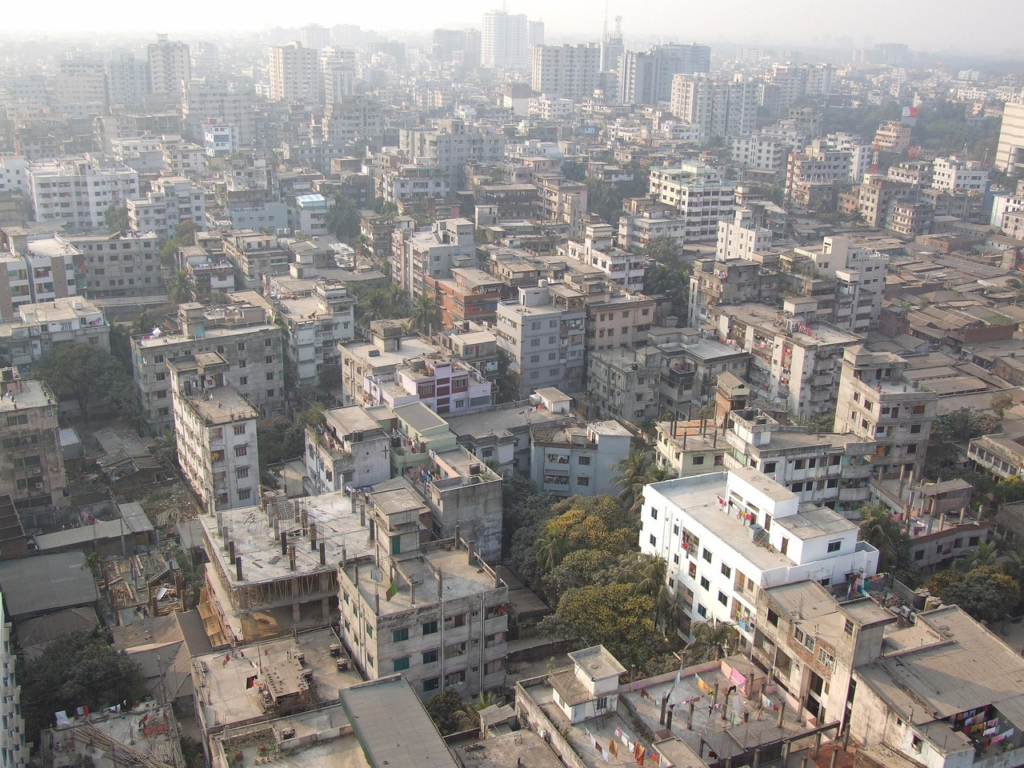
Dhaka, Bangladesh (credit: https://pixabay.com/).
These examples clearly illustrate that democracies sometimes consider the exclusion of political organizations to protect the very democratic system. Popularity alone does not itself grant the legitimacy of any political party. History warns against the idea that a large voter base immunizes a political party from legal scrutiny. In post-World War II Germany, constitutional provisions for the ban of extremist organizations were crafted precisely because the Nazi party, once an incredibly popular party, had previously exploited democratic mechanisms to abolish democracy. This historical experience informed constitutional frameworks that allow states to defend from the exploitation of democratic mechanisms to destroy democracy.
These reflect flaws in the argument of disenfranchisement in democratic politics. In a democracy, voters are not disenfranchised, even if a political party is not included in the ballot paper. It is rather the citizens who retain the right to vote and to organize politically in ways that uphold norms and values of democratic politics. What has been removed is rather the legal privilege and democratically destructive activities of a political organization that has monopolized politics.
Further distinction becomes crucial on the party’s large vote base, such as 30-40 percent. History rejects that a party’s large vote base makes exclusion illegitimate. Moreover, inclusivity in the elections is not arithmetic. An election is not democratic simply because more political party symbols appear on ballots. Rather, it is democratic because competition occurs within constitutional limits such as the rejection of political violence, accountability for the abuse of power, and respect for the rule of law. When a political party repeatedly violates those limits and refuses to acknowledge its wrongdoing, it exercises power without democratic consent and ceases to participate in democratic politics, such as the elections.
The claim of disenfranchisement in democratic politics consequently becomes misleading. But since a political party’s hardline approach is often determined by the extant political culture including revenge politics, it remains unclear whether the party can be solely blamed and responsible. Many political parties varyingly practiced political monopoly and destroyed democratic rights and elections. Moreover, banning a political party is not always a solution. Consequently, relatively acceptable political leaders of the BAL could have been given a scope for the 13th parliamentary elections.
Even if the BAL is not an electoral party, the elections need to be free, fair and credible. Free and fair elections are vital for democratic politics in Bangladesh. The Interim government needs to make sure that there are no irregularities in the elections. Voters need to be given the scope of casting their own votes and the declaration of the electoral results needs to be made authentic and as quickly as possible.
DISCLAIMER: The views expressed are those of the author(s) and do not necessarily reflect the views or official position of the Magazine and its editorial team. The views published are the sole responsibility of the author(s).
