

It might come as a shock to many, but Bangladesh hosts one of the largest refugee populations on earth, even though it is not involved in any armed conflict. Since 2017, Bangladesh has been hosting over a million Rohingya refugees from Myanmar who escaped their homeland due to extreme and systemic persecution. However, it should be noted that Bangladesh is not a signatory to key international refugee instruments such as the 1951 Refugee Convention and 1967 Protocol, nor does it have any national legislation on refugee protection, which raises several issues regarding how the rights of refugees are protected in a non-signatory state like Bangladesh.
The main purpose of refugee laws is the protection of refugees. When a person becomes a refugee, that person is extremely vulnerable because the absence of citizenship makes the enforcement of basic human rights uncertain and inconsistent. Refugee law exists to protect those who are forced to flee their home country due to persecution, war, or violence. The world formally recognized the refugee law in 1951 in a landmark agreement. The Refugee Convention includes basic things like the right not to be sent back into danger (called non-refoulement), access to shelter, healthcare, and legal protection. This law helps protect the rights of refugees. The 1967 protocol removed temporal and geographical restrictions that existed in the 1951 convention, making it applicable worldwide.
There is a complex dilemma, as there is no formal legal process to dictate who qualifies as a refugee and what rights they have but Bangladesh still hosts one of the largest refugee populations in the world. In 2017, the Bangladeshi government decided to refer to the Rohingya refugees as “Forcibly Displaced Myanmar Nationals” (FDMNs). It is not a legal term but a humanitarian one. This indicates that the displaced Rohingya people residing in Bangladesh do not have a recognized legal status. Consequently, they do not have the right to work legally, their movement is restricted to camps, and there is no straightforward approach to providing them with other deserving rights.
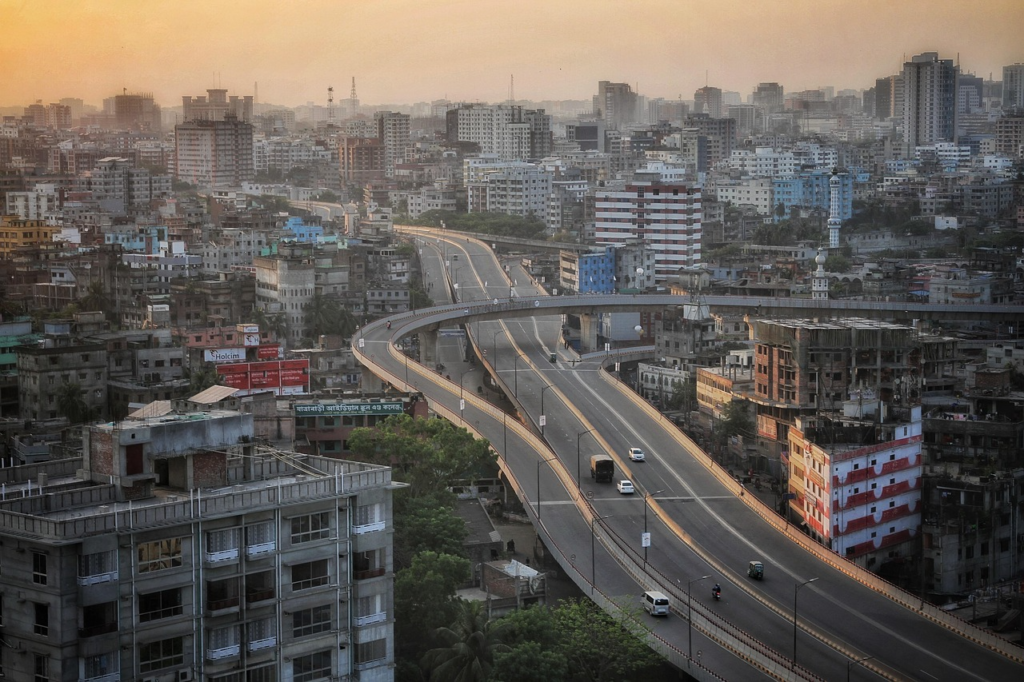
Dhaka, Bangladesh (Credit: https://pixabay.com/).
In spite of this, Bangladesh continues to host this massive refugee population with the assistance of international agencies like the UN High Commissioner for Refugees (UNHCR), the International Organization of Migration (IOM), and the United Nations Children’s Fund (UNICEF). But signing the 1951 Refugee Convention and its 1967 Protocol would significantly alter the legal landscape for the refugees in Bangladesh by establishing a structured and rights-based framework rather than the current ad hoc arrangement. Moreover, this will protect refugees in a better way and give them more freedom until they are repatriated to their homeland or any other permanent solution is reached.
The Rohingya refugee crisis is a global humanitarian crisis, and Bangladesh has been dealing with it as such for years. Even though it is not a signatory to the Refugee Convention, it is still obliged to respect key international principles, such as the principle of non-refoulement, which are considered a part of customary international law binding on all states. But in the absence of any legislation or framework regarding refugees, the country deals with this situation through its 1993 Memorandum of Understanding with the UNHCR, allowing refugee registration, aid operations, and access to some fundamental services. Alternatively saying, in practice, Bangladesh is practicing refugee protection.
The Rohingya issue was not created by Bangladesh. However, it has emerged as its most evident victim. Bangladesh has demonstrated an exceptional dedication to compassion and human dignity, even in the absence of the official legal framework of refugee law. But it is probably pertinent to transform that humanitarian impulse into a long-lasting legal and policy framework for displaced people who have come in search of safety, not just the Rohingya. Documentation and treaties are only one aspect of refugee law. Every country including Bangladesh needs to recognize that refugee protection is not just a legal issue, it is a moral one.
Although Bangladesh in itself has to deal with many challenges in economic and other terms, the refugee crisis created a further burden on it. Despite this, it is still providing and assisting shelter for years, something many first-world or developed countries are unwilling to do. It is crucial for the international community to step up since Bangladesh, already one of the most densely populated countries in the world, cannot bear this burden alone. The repatriation of a large number of refugees is stalled, and the third-country resettlement is minimal.
But it is vital to put emphasis on the repatriation of Rohingya refugees to their homeland. Repatriation is the best and most desirable solution, especially when the situation is stable in the home country. Along with the repatriation, resettlement in other countries can also be considered and approached to resolve the refugee crisis in Bangladesh. For this, the world needs to do a lot. But instead of assurances and commitment, a real move is vital.
DISCLAIMER: The views expressed are those of the authors and do not necessarily reflect the official views or position of the Magazine. Views published are the sole responsibility of the author(s).
