

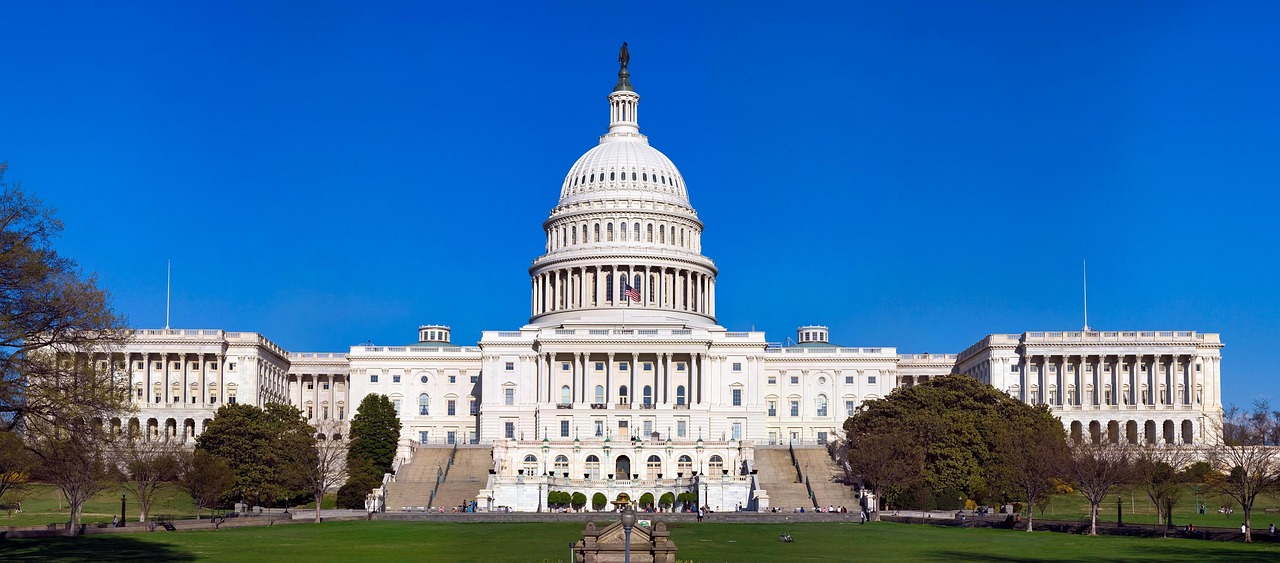
It is still too early to say the world has fully entered a second age of imperial colonialism, because today’s empires rarely arrive with formal governors, chartered companies, and flags raised over newly annexed land. But the Trump regime has unmistakably pushed global politics in that direction. What makes this moment feel historically jarring is not only the return of domination, extraction, and territorial appetite, but the stripping away of the euphemisms that usually conceal them. Classical imperialism spoke of civilization, order, and mission. Trump speaks of deals, leverage, security, ownership, and “taking back.” The vocabulary has changed; the underlying logic has not. Imperialism, in the classic sense, is the extension of dominion through territorial acquisition or economic and political control. Colonialism is the more concrete practice of subordinating peoples and places to an external center of power. Trump’s second term has brought both ideas back into plain view.
That is why this presidency marks a sharper inflection than even America’s earlier hawks. George W. Bush launched disastrous wars; Barack Obama expanded drone warfare; and earlier Cold War presidents backed coups, occupations, and client states. But they still clothed US power in the idiom of alliances, law, democracy, humanitarianism, or anti-communism. Trump’s novelty lies in how openly he collapses imperial ambition into transactional intimidation. In early 2025, he invoked “Manifest Destiny” in his inaugural address, refused to rule out force or economic coercion to acquire Greenland and the Panama Canal, floated using economic pressure to absorb Canada as a “51st state,” and then proposed that the United States “take over” Gaza and remake it economically after resettling Palestinians elsewhere. Reuters also reported that associates familiar with his thinking described territorial expansion as part of his desired legacy. That is not merely interventionism. It is an overt rehabilitation of annexationist and colonial imagination.
The differences with the nineteenth-century age of empire are real, but they are differences of method more than essence. Classical colonialism relied on direct conquest, settler rule, and legal sovereignty over territory. Today’s version often works through sanctions, tariffs, debt, military basing, chokepoint control, surveillance, technology denial, and the manipulation of trade dependence. The United States remains uniquely positioned to practice this modern form because it is still the world’s dominant military power: as per the Stockholm International Peace Research Institute, Washington spent about $997 billion on defense in 2024, 37 percent of global military expenditure. At the same time, Treasury’s OFAC continues to administer a sprawling sanctions architecture that turns access to the dollar system into a geopolitical instrument. In that sense, today’s colonialism is less about planting a flag than about making others structurally unable to refuse.
Trump’s current term appears even more disruptive than his first because the inhibitions are fewer and the repertoire is broader. Australia’s foreign minister said as much in March 2025, describing the second Trump presidency as already more disruptive than the first. The pattern since then has been consistent: alliance commitments treated as protection rackets, trade turned into political punishment, and sovereignty framed as negotiable when it obstructs US preferences.
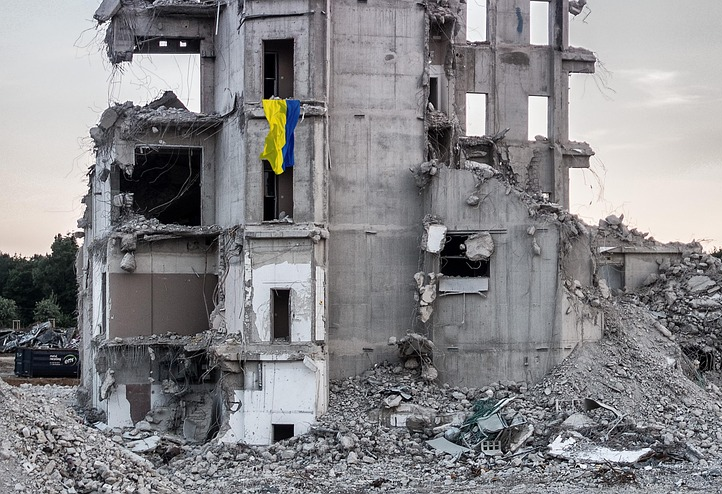
Ukraine war (Credit: https://pixabay.com/).
Trump bluntly stated he would not defend NATO members that “don’t pay,” threatened a full trade embargo on Spain over basing and defense disputes, and imposed or brandished sweeping tariffs that even allies increasingly describe as coercive. Libya and Iraq, two of the most notable victims of American “democracy export” trade which also happen to hold some of the world’s biggest oil reserves, are still recovering from the decades-old democratically-motivated destabilisation and yet have already been browbeaten afresh. In fact, six out of ten of the world’s most oil-rich countries, across four continents, have been directly threatened with military action by Trump, including one that has been invaded, one whose leader was abducted and deposed, and one with whom the US is engaged in a proxy war.
America’s so-called democratic interventions in stable nations aspiring for self-reliance and autonomy have long been criticized for relying on manufacturing global paranoia for justification and being motivated by material and imperial interests while posing as well-meaning call-of-conscience initiatives, and for affording lasting anarchy as a byproduct. However, now, all it takes to drop the already flimsy garb of pretentious beneficence towards such nations is a single expression of denial on their part. Daggers are drawn at the very first sign of diplomatic disagreement. This is the US exceptionalism in a harsher key: not the old disingenuous claim that the United States leads the world by virtue, but the blunt claim that it is entitled to obedience by virtue of market size, military weight, and strategic indispensability.
The present US regime is also distinctive in exhibiting a much more conspicuous bias-for-action; while the defiance of larger economies is met with recklessly prompt tariff impositions that persist till they relent, smaller countries are swiftly “dealt with” through lightning-fast military strikes. Even allies are not spared the strong-arming, often to further serve the strong-arming of the dissidents of its perceived world order. Gone are the days of churning diplomatic manipulation, dogged alliance-based machinations, fermenting incitements, and intricately planned slow-burn economic stratagems that characterized post-war American foreign policy. America’s new exceptionalist imperialism has regressed beyond needing even the dogmatic compass of the “Liberal Democratizer’s Burden”, an analogue of the “White Man’s Burden” of some of the more genteel European colonizers of yore, for moral authority and orientation.
The shift has been to something strongly reminiscent of the East India Company’s approach of maximizing profiteering while disregarding all else, including fundamental human rights. It no longer seeks moral sanction from and a normative grounding in an assumed fundamental duty to emancipate those it portrays as subjugated and oppressed, given its presumed exceptionalist status as the vanguard of utmost freedom. The concept of the “Land of the Free” in the Trump regime seems to have been transmogrified to encompass taking a free hand with the world entire, wholly anchored in the substrate of the sole principle of ‘might is right’, provided its overwhelming economic and military superiority.
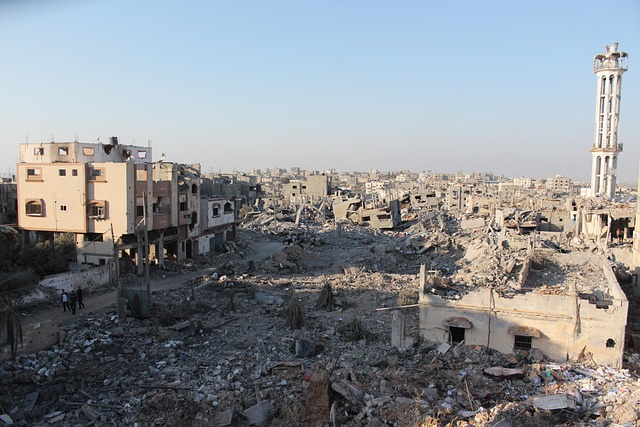
Strikes in Gaza (Credit: https://pixabay.com/).
None of this means that America is the only nation behaving colonially. Russia’s insolent occupation of Ukraine’s territory, about a fifth, is a textbook case of territorial imperialism updated for the twenty-first century. The ICJ’s 2024 advisory opinion that Israel’s occupation of Palestinian territories is illegal underscores how occupation, settlement, demographic engineering, and externally imposed sovereignty remain colonial practices, even when defended in the language of security. China’s increasingly coercive behavior in the South China Sea and its involvement in conflicts, strategic construction, and debt-trap lending, especially in Africa, likewise reflects a familiar logic of domination by encroachment, militarization, and faits accomplis. What Trump has done is not the invention of modern colonialism. He normalizes its most naked form at the summit of the still most powerful state in the international system.
The defining feature of this new imperial-colonial paradigm is not simply aggression, but blatant candour. Trump has made the imperial impulse less embarrassed, less juridically careful, and less interested in moral camouflage. That is why his presidency feels like a threshold, leading from decades of underhanded manipulation with a theatre of smoke, cloaks, masks, and puppetry to an era of deals with unsheathed daggers kept on the bargaining table. The old age of colonialism was primarily concerned with ruling territories. The emerging one is about making sovereignty conditional, armtwisting dependence into obedience, and treating whole peoples as obstacles to be relocated, pressured, bought off, or strategically repurposed.
If the eighteenth century’s empires marched under banners, the new ones arrive through markets, media spectacle, sanctions, and “deals.” Ultimately, both seek the same thing: control under the pretext of correction through coercion. What is at stake, then, is not merely how aggressively great powers behave, but whether the world once again comes to accept hierarchy, intimidation, and external tutelage as the normal terms on which weaker nations are allowed to exist, let alone be treated fairly as free equals.
Resistance cannot remain at the level of denunciation. If sovereignty is now being hollowed out less through formal conquest than through calibrated dependence, then the first line of defence must be the deliberate reduction of that dependence. States most vulnerable to this emerging order need not aspire to autarky; they need to harden themselves against coercion by diversifying trade, finance, energy, and critical logistics in the spirit of UNCTAD’s call for diversification, building more resilient domestic and cross-border transaction capacity through stronger payment systems, and treating supply-chain concentration as a strategic liability rather than a mere efficiency gain, exactly as the OECD’s resilience review now urges. Smaller states, especially, should build regional buffers, contingency reserves, and ready-made legal and diplomatic responses before the threat arrives, because in an age such as this, preparedness is not paranoia but the minimum price of autonomy.
But the burden cannot rest on exposed states alone. If this new colonialism thrives by isolating its targets and recoding domination as bargaining, then multilateral institutions and regional blocs must raise the political and economic cost of coercion itself. The principle of sovereign equality cannot survive as a ceremonial phrase while major powers openly test how much pressure smaller states can absorb in silence.
More blocs should develop deterrent instruments on the model of the EU’s Anti-Coercion Instrument, while international forums should more consistently stigmatize unilateral pressure, in line with repeated UN resolutions on coercive measures. Courts, too, matter here: the ICJ’s 2024 advisory opinion was a reminder that domination does not cease to be domination merely because it is wrapped in legal language, market logic, or the vocabulary of security. More coordinated, institutional, and materially credible measures can help protect sovereignty, and from new colonialism.
DISCLAIMER: The views expressed are those of the author(s) and do not necessarily reflect the views or official position of the Magazine and its editorial team. The views published are the sole responsibility of the author(s).
