

The Transparency International Bangladesh (TIB) held a discussion meeting on 09 December 2025 on the occasion of the International Anti-Corruption Day at Dhanmondi, Dhaka, Bangladesh, on “Bangladesh’s Media Landscape After the Fall of Authoritarianism”. The keynote paper was presented at the discussion by Zafar Sadiq, the Deputy Coordinator of TIB’s Outreach and Communication Department. His presentation at the discussion meeting analyzed the historical trajectory and legal framework of the media in Bangladesh, the challenges facing media institutions and journalism, the modes of registration and ownership, and offered an in-depth discussion of the current media environment following the fall of the authoritarian regime.
The officials of the TIB, including the Executive Director, academics, editors, and journalists participated in the discussion. Indicating adversarial attitudes, TIB’s Executive Director, Dr. Iftekharuzzaman, said, “The media does not stand outside the country’s overall political and bureaucratic structure. As a producer of essential public goods — news, information, and reports — its rightful place should be as the government’s most important ally in serving the public interest. Yet every government in Bangladesh has consistently treated the media as one of its adversaries. As a result, instead of undertaking much-needed reforms for a free press, what has happened under the interim government in the name of reform — especially through ordinances related to cyber security, personal data protection, and national data governance — has only strengthened the state’s surveillance and control. This has deepened concerns over press freedom, freedom of expression, and overall freedom of speech…”
The media has been playing a vital role in Bangladesh. Speaking at the discussion, Dhaka Tribune Editor Reaz Ahmad highlighted the media situation and public trust in it and said, “… Yet, over the past years, the media environment has been polluted — and this culture continues. The media has been manipulated to such an extent that no one can even claim that the media is not free, because a system has been created where anyone can get a license. But on what grounds are these licenses being issued? As a result, public trust in the media is declining.”
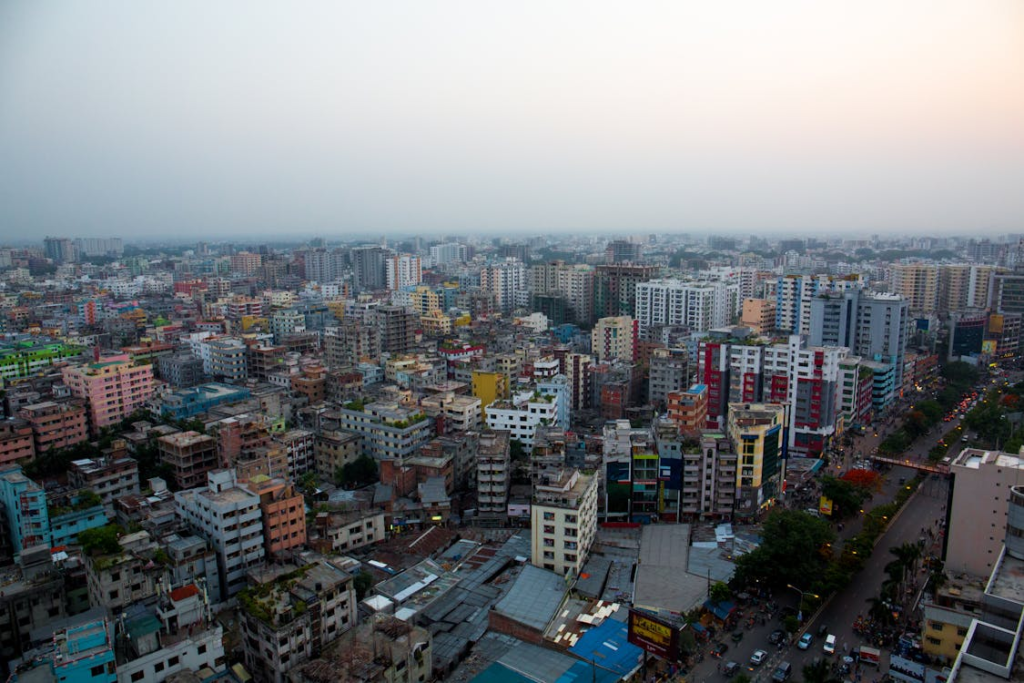
Dhaka City (Credit: https://pixabay.com/).
Indicating beneficiaries within the media and impacts of trust, Dr. Iftekharuzzaman said, “In Bangladesh, the growth of authoritarianism had an important accomplice: the media. In many cases, the media surrendered. Some even became ‘enemies within’ in exchange for benefits and privileges. As a result, the credibility of the entire sector has come under threat, especially because those in the media who have fallen into professional bankruptcy have affected public trust…” Highlighting some unscrupulous practices after 5 August 2024, he further said, “….After the political shift, some within the media who now consider themselves victorious have fallen into a mindset of ‘now it’s our turn,’ desperately trying to continue the same practices. In doing so, they have pushed the emerging possibilities for reform towards failure.”
Putting importance on the implementation of the Media Commission’s recommendations, Shahnaz Munni, the former Chief News Editor of News24, said, “Discussions on establishing a Media Commission and implementing its recommendations are positive. Ahead of the upcoming election, we hope political parties will commit to implementing the Commission’s recommendations. In the past, even with fewer channels, a strong story could shake society, if not the government. Now, the number of media outlets has increased — but so has the noise. Women’s representation in the media remains low, and many women are reluctant because the working environment has not improved.”
Highlighting the discrepancies between the Interim Government’s commitment and its actions on media reforms, Dr. Iftekharuzzaman added, “Much of what is necessary for media reform has still not been implemented. Every reform commission proposed many actionable and urgent recommendations. The government itself had requested a list of proposals that could be implemented immediately. Yet none of these were carried out. Where, then, were the obstacles? Everyone speaks in favor of reform, but those who should drive reform from within are often the ones playing a preventive, gatekeeping role — most notably the bureaucracy. For true reform, both the political culture and the bureaucratic structure must change…”
Putting importance on the quality of journalism and the improvement of the capacity to deal with new challenges, Talat Mamun, the former Executive Director at Channel 24, said, “Journalism is facing many challenges, and the lack of trust is one of the biggest. But instead of losing hope, we must ensure quality in news media. There is a lack of unity among journalists, which is a professional weakness. After authoritarianism collapses, new forces emerge. Journalists must prepare themselves to deal with those.”
Highlighting the importance of the media and their continuation, AFP Bangladesh Bureau Chief Sheikh Sabiha Alam said, “Information alone can dispel misinformation. Similarly, journalism will defeat pseudo-journalism. Despite many challenges in recent years, we have seen strong and impactful reporting. Therefore, journalism must continue. The more it continues, the more public confidence will grow.”
NB: Dhaka Opinion Magazine does not send its editorial team members to cover press conferences, conferences, seminars, workshops, or any other event. It selectively publishes Opinion Roundup, Conference Overview, and Convention Overview when opinion-based press releases, conference proceedings, or other similar materials are submitted or sent to the magazine. But these are subject to editing before publication based on the policy of the magazine.
DISCLAIMER: The views expressed are those of the authors and do not necessarily reflect the official policy or position of the Magazine and its editorial team. Views published are the sole responsibility of the author(s).
