

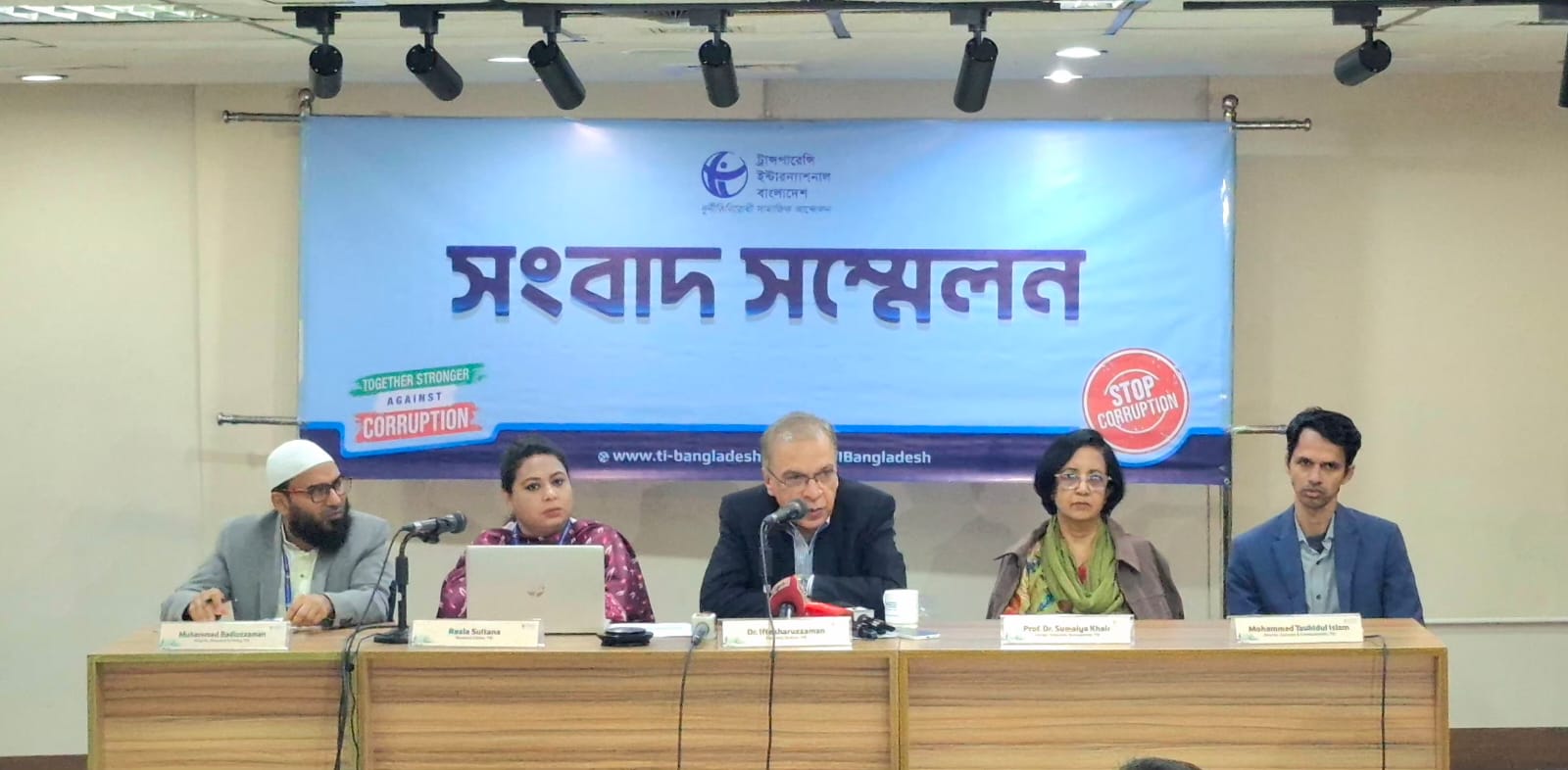
Indigenous peoples in the plains and hill regions of Bangladesh face corruption and irregularities in accessing government social security net programs. In food- and commodity-based schemes, beneficiaries are reportedly forced to pay bribes ranging from 500 to 10,000 taka. The research report entitled “Inclusion of Indigenous People in Social Security Net Programs: Governance Challenges and Way Forward” carried out by the Transparency International Bangladesh (TIB) conducted from June 2024 to November 2025 and presented at the TIB’s Dhaka office on December 02, 2025 also indicated allocations, gaps in legal and policy frameworks, exclusion from expected benefits, and lack of transparency in beneficiary selection.
The report prepared from the research that covered 11 districts across eight divisions, including eight plains and three hill districts, and presented at the press conference, attended by Dr. Iftekharuzzaman (TIB’s Executive Director), Prof. Dr. Sumaiya Khair (Adviser, Executive Management), and Muhammad Badiuzzaman (Director of Research and Policy), highlights corruption in food- and commodity-based programs and notes that different groups of people such as Union Parishad members, chairmen, village police, and Upazila Social Services officials are involved in bribery. The report presented by Research Fellow Razia indicates that under the lifelong old-age allowance, Indigenous people of the plains pay a one-time bribe of 500–10,000 BDT, while those in the Chittagong Hill Tracts pay 2,500–6,000 BDT.
Similarly, in the WVB food-based programe, bribes range from 2,000–10,000 BDT for plains Indigenous people and 2,000–6,000 BDT for hill communities. The report, presented in the press conference, further indicates that one of the main preconditions for establishing peace is eliminating discrimination and ensuring the rights of the concerned communities. The report presented at the conference further notes that the share of social safety in GDP has gradually declined from FY 2020-21 to FY 2025-26. Despite international recognition of Indigenous identity and traditional land rights under ILO conventions, Bangladesh has not ratified them.
Dr. Iftekharuzzaman, the TIB’s Executive Director, said, “In each of the seven indicators of the study, deficits in good governance and transparency, and an alarming picture of corruption and irregularities, have been revealed. From this, it is clear that the state is failing to ensure the rightful entitlements of Indigenous communities… Due to weaknesses in policy frameworks and legal structures, the commitments made by the government have also not been implemented. The formulation of a Strategic Context Plan in the Chittagong Hill Tracts, which was part of the government’s Five-Year Plan, and similarly the announcement of forming a separate Land Commission for Indigenous peoples of the plains, have not been implemented. These commitments made by the government must be implemented without delay.”
The 1997 Chittagong Hill Tracts Peace Accord partially recognized Indigenous land rights, but national law provides no recognition of traditional land ownership. Bangladesh’s Eighth Five-Year Plan (2020–2025) addresses issues only in the hill regions, leaving the plains’ Indigenous peoples unprotected. The absence of a separate Land Commission has led to loss of inherited land and evictions. In hill areas, remoteness and limited staff pose challenges in verifying beneficiary lists. Indigenous representatives are largely excluded from planning and selection committees, and programs often overlook local needs and geographical diversity. Online applications are hindered by a lack of internet, electricity, and mobile coverage in remote areas, while outreach remains insufficient due to geographical barriers.
Indigenous peoples are positioned at the marginal level even among marginalized groups. Referring to the programmes conducted by the government, Dr. Iftekharuzzaman said that there is a lack of rights-based sensitivity toward the problems of marginalized Indigenous communities. Dr. Iftekharuzzaman also said, “A kind of majoritarianism exists within the state structure. As a result, we do not see the realization or recognition of the rightful dues and rights of Indigenous communities. The discrimination based on the ‘we and they’ culture is not limited only to Indigenous peoples; its coercive practice is reflected in all spheres across religious, gender, ethnic, and socio-cultural identities under various standards…”.
To address these issues, the report makes several recommendations, including ratifying ILO Convention 169 for constitutional recognition and rightful entitlements of Indigenous peoples; explicitly prioritizing Indigenous communities in all social security program security guidelines with dedicated budget allocations; and simplifying application processes, birth registration, national ID issuance, and other documentation to make them Indigenous-friendly. Regarding the importance of the ILO Conventions, Dr. Iftekharuzzaman said, “…We are demanding Bangladesh’s ratification of ILO Convention 169 as soon as possible, along with constitutional recognition of Indigenous peoples’ right to self-identify as ‘Indigenous’…“.
Indicating the importance of establishing the rights of Indigenous people, Dr. Iftekharuzzaman said, “Establishing equal rights is one of the key preconditions for establishing a discrimination-free and peaceful democratic society, and in that respect, it has not been possible to include Indigenous communities within the mainstream of social protection and security. Indigenous communities are revolving within a cycle of irregularities and corruption. This picture must be prevented…“.
NB: Dhaka Opinion Magazine does not send its editorial team members to cover press conferences, conferences, seminars, workshops, or any other event. It selectively publishes Opinion Roundup, Conference Overview, and Convention Overview when opinion-based press releases, conference proceedings, or other similar materials are submitted or sent to the magazine. But these are subject to editing before publication based on the policy of the magazine.
DISCLAIMER: The views expressed are those of the authors and do not necessarily reflect the official policy or position of the Magazine and its editorial team. Views published are the sole responsibility of the author(s).
