

The 13th parliamentary elections have led to an elected government in Bangladesh, after almost one year and six months of the interim government. The transition to the elected government from a chaotic political ground has raised hopes and increased the possibility of addressing many challenges and concerns Bangladesh has been facing for years. But the public expectations including economic improvement, carrying out proposed reforms and improvement in political culture are unsurprisingly high from the government. But —importantly — how much the BNP-led government will address public concerns remain uncertain, even if it has a super majority, indicating a strong public mandate capable of making constitutional reforms on its own.
There are various challenges and expectations in economic terms. There has been high inflation, consistent decline in per capita income, slow economic growth, rising public debt, economic corruption and weakened financial institutions over the years, though the interim government made efforts for the reduction in inflation, strengthening banking sector discipline and addressing the concerns of economic corruption. The economic mismanagement of the BAL government for years and the borrowing dependency of the interim government have impacted the economy. Political movements in 2024 and subsequent volatile political conditions have immensely contributed to economic degradation over the last few years. But, consequently, there were closures of industries, reduced income opportunities including opportunities for entrepreneurial opportunities, reduced income and high living costs for many.
Reforms are vital for making desirable changes in the national constitution. The constitutional reform proposal, known as the July Charter, was put forth after the mass uprising against the misrule of the then BAL government in 2024, with the aim of not only reducing the chance of fascism in Bangladesh but also strengthening state institutions and improving the space for accountability. Much-talked-about constitutional reform finalized by the interim government in consultation with political parties has controversies including the formation of the upper house since its beginning. But the several latest developments over the reform, which was given support by the people through the referendum, have increased the chance of political trouble in the coming days, at least somewhat.
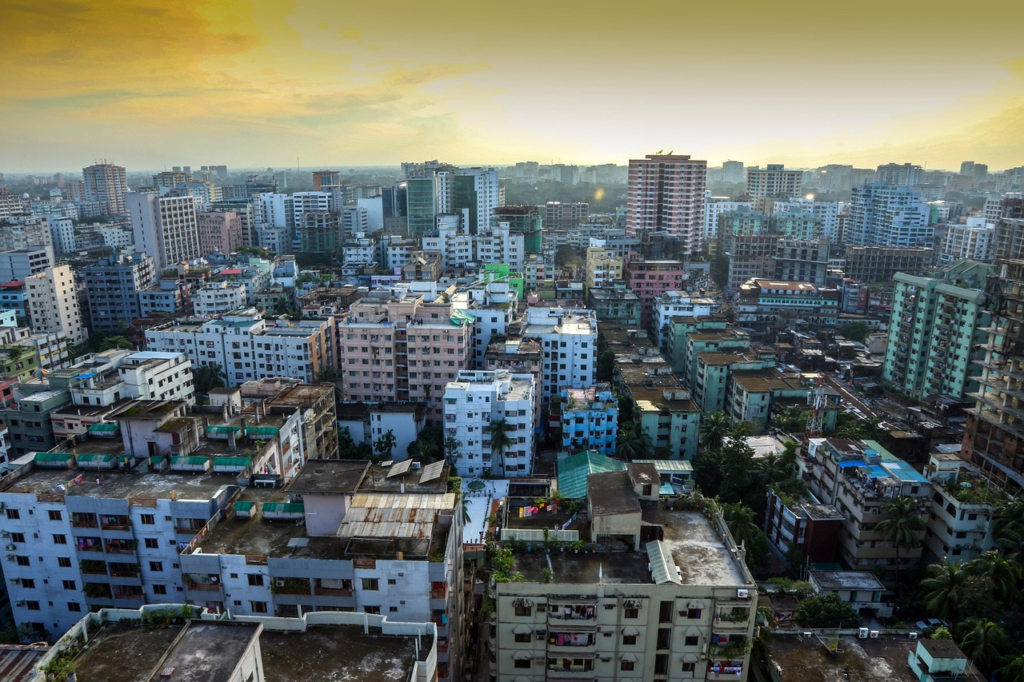
Dhaka, Bangladesh (credit: https://pixabay.com/).
The differing position of the government and the opposition on several grounds including several key reform proposals in the July Charter, oath taking as members of the Constitutional Reform Council —where the BNP MPs have not taken such oath but Jamaat-i-Islami and NCP MPs have separately taken such oath — and the formation of the Constitutional Reform Council, which was supposed to be empowered to exercise all authority related to constitutional reforms, have led to political rhetoric and threats of political demonstrations. The ruling party has said the matter of the constitutional reform Council could be discussed in parliament. These have led to the growing negative perception of doubt on whether and how much reforms will be made.
The improvement of political culture has been challenging for decades. Cadre politics, the culture of extortion by ruling party men, the culture of illegally grabbing lands by ruling party men, and the de facto indemnity of ruling party men are some crucial political challenges. Every government fails to address these because of the perception of the need for cadre politics to tackle other parties, the involvement of many top-level political leaders of the ruling party and corruption in public institutions. Of other harmful political cultures, flattery is to be specially noted. It hinders the development of a reasoned-based state and deprives others especially those whose reasons go against the unreasoned interests of the government or the ruling party men.
Hopefully saying, the government has shown several positive indications of making changes. Decision to refrain from buying tax-free vehicles for MPs, Family Card —as pledged before the elections — and decision to engage MPs in the cleaning of respective constituencies are some notable decisions that reflect the government’s commitment to the people. Moreover, the BNP-led government has not said it will not carry out the constitutional reform. But there are various challenges ahead to the elected government including the political culture of manipulating power and taking unfair opportunities by the ruling party and the party-favored attitude toward almost everything that can play certain roles if not addressed.
The extreme party-favored attitude needs to be detailed a bit. Almost all elected governments in Bangladesh have strictly adopted and implemented a party-favored stance for providing positions, opportunities and benefits of the state, ranging from selecting top-level posts to creating companies to providing root-level opportunities. Consequently, the opposition and others have often remained outside the scope of getting deserving positions, creating companies, getting jobs and other opportunities, while ruling party men have been benefiting over the decades. But a nation cannot move on desirably if a significant portion of its people remain outside the deserving positions or opportunities because of political affiliation.
The government needs to address economic and other concerns. But emphasis needs to be given to increased investment, generating income opportunities including providing better conditions for entrepreneurship and preventing money laundering. Even if the BNP-led government does not implement the reform as it is, it needs to talk to the opposition —rather than disregarding reforms altogether. Their discussion will help address different concerns, carry out reforms and reduce the chance of major political instability. But economic and other opportunities need to be given to all, regardless of party affiliation.
Political culture needs to be improved. But it is not an easy thing to do. The extant manipulative, might-based, party-favored and opposition-intolerance political cultures were established over the decades. But a strong political commitment will help improve political culture. The role of the ruling party is core to it. But opposition political parties also need to play their roles to improve the political culture and avoid political conflicts especially unreasoned conflicts.
